
UPDATE on USA Import tariffs as of the 3rd September 2025
We are pleased to announce a resumption of sales to the USA, as orders can now be sent via Royal Mail DDP (Delivery Duties Paid) service, which meets the new US customs requirements since the removal of the De minimis $800 duty free threshold. The import duty will be added to your order at the checkout stage and forwarded to US customs by the carrier on your behalf after shipping, enabling your purchase to process through US customs without further duties applied.


Click Image to View Gallery
This large surveying compass made during the first half of the 19th century, features foldable sight vanes and is housed in an attractive mahogany case.
Uniquely, it has a double hinged two part lid which when closed slides snugly over two brass posts, while two brass clasps hook into the slots in the posts, securing the lids tightly, protecting the glass and sight vanes and also engaging the transit lock.
Although unsigned, the unusual design would suggest it may have been made to order as a special or prototype, and its not a design I have ever come across before.
The black and white paper dial is in relatively good condition for its age, although lightly stained around the edge in one place (see photo) and is otherwise perfectly legible.
In good working order, the cross bar steel needle pivots on a gemstone bearing, encircled by a border of 24 miniature starbursts, with the traditional dial layout divided into four 90-degree quadrants, all beneath a clear glass crystal.
A substantial compass it weighs just over 280 grams and measures 4 ¾"(122mm) square.
| Shipping and any applicable taxes will be calculated at checkout according to destination | ||||||
| Price | Code | UK | EU | USA/CAN | AUS/NZ | RoW |
| £220 | SC2833 | Free | £13 | £20 | £22 | £21 |

Click Image to View Gallery
The famous 'PROSPECTING COMPASS' designed and patented by Francis Barker was often made by other makers, including Dollond and Negretti & Zambra under license, or rebranded for them by Barker.
This particular example carries not just the patent number, but also the original patent date 1906, which coupled with the Francis Barker name would suggest it to be one of the earliest ones produced, and is engraved on the underside 'PAT No 12777, F.BARKER & SON MAKER LONDON'.
Advertised as suitable for Prospectors and others, it has a hinged lid which incorporates a domed magnifying glass, and was used by prospectors for close inspection of precious metals, as well as a burning glass when looking to start a fire without flint.
The brass snap hunter case houses a directional needle painted N & S for clarity which freely pivots on an agate bearing inside a raised 360 degree graduated scale.
In good working order with a strong hinge and manual transit lock, the compass body retains much of its original black finish and comes in a later velvet pouch for protection.
Weighing just under 80 grams it measures 46mm in diameter by 20mm deep.
| Shipping and any applicable taxes will be calculated at checkout according to destination | ||||||
| Price | Code | UK | EU | USA/CAN | AUS/NZ | RoW |
| £230 | SC2831 | Free | £12 | £18 | £19 | £19 |

Click Image to View Gallery
A fine example of a prismatic compass and Watkin's clinometer combination, made by James Joseph Hicks in the second half of the 19th century, and housed separately in a fitted leather case.
The prismatic compass has 'J.HICKS, 8 HATTON GARDEN, LONDON' printed on the green card dial, and the clinometer has a brass bar reading 'WATKINS CLINOMETER PATENT 217. J.HICKS. MAKER, 8 HATTON GARDEN LONDON'.
Weighing just over 450 grams in the case, both compass and clinometer are in good condition and fully functional, although there is some light tarnishing on the internal clinometer mirror, but the numbers viewed are still legible.
Some handwritten words on the leather case have been crossed out, presumably by previous owners.
| Shipping and any applicable taxes will be calculated at checkout according to destination | ||||||
| Price | Code | UK | EU | USA/CAN | AUS/NZ | RoW |
| £210 | SC2832 | Free | £14 | £22 | £24 | £22 |

Click Image to View Gallery
An unusual Hunter cased combined pocket compass and clinometer with integral folding sight vanes.
A substantial instrument made from nickel plated brass, the dial pattern is German, note the “O” (Ost) for East, so it was most likely made for export to foreign markets.
It has two foldable sight vanes set above an etched 360 degree stepped outer chapter ring, beneath a clear crystal that protects a blued steel needle with a red gemstone bearing. There is also a pendulous brass arm for taking clinometer readings, and a practical side lever-operated transit lock to hold the needle in place when not in use.
Measuring 80mm in diameter by 25mm in depth and weighing just under 300 grams, it shows some minor plating loss on the lid and near the hinge.
In good working order, the lid clasps shut securely, offering solid protection when closed.
| Shipping and any applicable taxes will be calculated at checkout according to destination | ||||||
| Price | Code | UK | EU | USA/CAN | AUS/NZ | RoW |
| £150 | SC2830 | Free | £13 | £20 | £22 | £21 |

Click Image to View Gallery
This elegant brass cased explorer’s style compass with a separate push fit lid dates to the second half of the 19th century.
An unsigned example, it has a stylish blued steel directional needle engraved N & S in gold lettering which pivots on a brass capped bearing above a traditional dial, denoting 32 cardinal and inter cardinal points under a clean undamaged crystal.
In good working order and measuring 60mm in diameter, the brass case does have some light age tarnish but otherwise in good condition and comes with a modern velvet drawstring pouch for added protection.
| Shipping and any applicable taxes will be calculated at checkout according to destination | ||||||
| Price | Code | UK | EU | USA/CAN | AUS/NZ | RoW |
| £135 | SC2822 | Free | £12 | £18 | £19 | £19 |

Click Image to View Gallery
This antique surveying compass with folding sight vanes is set in a polished mahogany case and fastened by twin brass clasps.
The anodised brass vanes sit above an English crossbar needle pivoting on a gemstone bearing over a silvered dial, featuring a stepped outer chapter ring with a 360 degrees scale in one degree increments, beneath a chip free glass.
Dating to the second half of the 19th century, like many wood cased compasses of the period it's unsigned, but clearly a compass of some quality, probably made by one of the prominent makers of the day.
In good working order, the lid has a blue velvet clad recess that protects the vanes when closed and also activates the transit lock to hold the needle in place when on the move.
Measuring 78mm square by 27mm deep and weighing just over 220 grams, it's also in very good cosmetic condition.
| Shipping and any applicable taxes will be calculated at checkout according to destination | ||||||
| Price | Code | UK | EU | USA/CAN | AUS/NZ | RoW |
| £190 | SC2816 | Free | £13 | £20 | £22 | £21 |

Click Image to View Gallery
An unusually large example, this early Victorian travellers pocket brass compass measures 90mm in overall diameter by 25mm high and comes with a separate push fit lid.
The traditional hand drawn floating dial has 32 cardinal and inter cardinal points with a Fleur De Lis denoting North and pivots on a clear gemstone bearing, housed under a clean glass crystal which is free of any chips or cracks.
The brass case and matching lid are free of any dings or dents and in original uncleaned condition.
A substantial piece weighing just under 230 grams, it's unsigned but the dial pattern is the first design used by Francis Barker during his apprenticeship and continued to be used throughout the 19th century.
| Shipping and any applicable taxes will be calculated at checkout according to destination | ||||||
| Price | Code | UK | EU | USA/CAN | AUS/NZ | RoW |
| £160 | SC2818 | Free | £12 | £18 | £19 | £19 |

Click Image to View Gallery
This WW1 H.A. MK 1 Angle of Sight instrument with a low serial number 65 was made by J.H. Steward in 1915, and comes in a similarly marked leather case dated 1916 with inked writing that reads "U" BATTERY AA 21st SECTION, No 296.
I believe this refers to U Anti-Aircraft Battery 21st section, that landed in France on the 14th May 1915.
Most examples I have seen in the past were from the WW2 period, so quite unusual to find one this early in such good condition.
Constructed from bronzed brass, its engraved 'Angle of Sight Instrument, H.A.MK I, J. H. Steward Ltd, 1915, No 65'.
A precision instrument which incorporates a prismatic compass, consisting of a green card dial with Fleur de Lis North pointer, and a clinometer visible in the vertical plane.
In very good condition retaining virtually all its original finish, it's in full working order and although the leather case has had some repairs it's still relatively sound.
Weighing 425 grams in its case, it measures 70mm in diameter across the main body.
| Select your shipping destination at ORDER page | ||||||
| Price | Code | UK | EU | USA/CAN | AUS/ NZ | RoW |
| £250 | SC2784 | Free | £14 | £22 | £24 | £22 |

Click Image to View Gallery
George S Wood worked at 20 Lord St Liverpool between 1875 and 1894, having taken over the business of Abraham Abraham & Co.
This large mahogany cased surveying compass was made around 1880 and is signed 'G. S. WOOD. ABRAHAM & CO, 20 LORD ST. LIVERPOOL.'
The English cross bar needle pivots above an attractive silvered dial on a gemstone bearing, and has a stepped outer chapter ring with a 0-360 degrees scale in one degree increments.
A substantial compass weighing just over 600 grams and measuring 5¾" (145mm) square, it's visually very impressive, and although no longer usable for surveying due to the missing integral sight vanes, fortunately it doesn't affect its use as a directional compass, with the needle accurately finding North and a working transit lock.
Generally in good cosmetic condition, there are some minor scrapes on the case lid, but no splits or cracks, and the holes left by the sight vanes have been filled with wax, making them less noticeable.
| Select your shipping destination at ORDER page | ||||||
| Price | Code | UK | EU | USA/CAN | AUS/ NZ | RoW |
| £230 | SC2764 | Free | £14 | £22 | £24 | £22 |

Click Image to View Gallery
This unsigned early 20th century gimbal mounted ships compass was very likely made by Henry Browne & Son, the important and highly respected maker of quality nautical instruments, used on naval & merchant ships since the mid 19th century.
Despite not having the famous Sestrel logo on the dial North point, or the numbered 360 degree outer scale, in all other respects the dial design is the same, which suggests this may have been made on a wholesale basis for rebranding by a ships chandler or similar.
The 5" diameter compass bowl is gimbal mounted in a wooden box measuring 8½"x 8½ by 5½" high with a separate removable lid fastened by two brass side clasps.
The dry card floating dial pivots on a gemstone bearing, has 8 main cardinal points with numerous minor divisions, and North is denoted by the same fleur de lis inset as found on a branded Sestrel dial.
In very good condition all round, the card dial is clean and the glass cover is free from any chips or cracks.
An impressive compass in good working order and would look great in most surroundings, it is a substantial piece weighing just under 2.2kgs.
| Select your shipping destination at ORDER page | ||||||
| Price | Code | UK | EU | USA/CAN | AUS/ NZ | RoW |
| £130 | SC2762 | Free | £19 | £33 | £36 | £36 |

Click Image to View Gallery
An early Victorian pocket compass set in a mahogany case, with an attractive paper sunburst dial, divided into 90 degree quadrants and displaying 32 cardinal and inter-cardinal points.
Dating to around 1870, it has its original glass crystal which is retained by a bronzed brass bezel, and a stylish blued steel needle, impressed with ‘N’ & ‘S’ gold letters.
As with many wood cased compasses of the period this is unsigned, but the use of concealed hinges attaching the lid to the base, was a feature used predominately by Francis Barker, and it’s very likely this compass was made by Barker.
This is a nice clean compass, with both crystal and dial in very good condition and a transit lock activated on lid closure, fastened with two brass clasps.
Weighing just under 90 grams, and measuring 88mm x 88mm x 22mm, it's in good working order.
| Select your shipping destination at ORDER page | ||||||
| Price | Code | UK | EU | USA/CAN | AUS/ NZ | RoW |
| £190 | SC2757 | Free | £11 | £15 | £16 | £16 |

Click Image to View Gallery
Founded in 1830 by Andrew Ross, the company was one of the most important instrument makers of the 19th century, making significant contributions to the development of camera lenses. After his death in 1859 the company continued under Thomas Ross and became known as Ross & Co with a reputation for high quality instruments, winning gold medals at various exhibitions in London, Paris and Philadelphia.
This bronzed brass green card prismatic sighting compass is signed ' ROSS Ltd, 31. COCKSPUR ST. S.W.' and dates from the end of the 19th century when the company was renamed ROSS Ltd.
A precision instrument of high quality in its time, it was likely used for surveying by both military and civilian personnel.
In very good cosmetic condition, the floating green card dial pivots on a gemstone bearing under a clean crystal, and comes in its original leather case, which has seen some repairs but is still complete and robust.
In good working order, the large upright sight vane locks the compass card for transit, and the front prismatic viewer has a brass swivel dust cover.
Measuring 70mm in diameter with the compass and case together, it weighs just under 300 grams.
| Select your shipping destination at ORDER page | ||||||
| Price | Code | UK | EU | USA/CAN | AUS/ NZ | RoW |
| £150 | SC2736 | Free | £13 | £20 | £22 | £21 |

Click Image to View Gallery
This 19th century combined pocket compass & clinometer housed in a mahogany case, features an elegant blued steel needle, impressed with “N” and “S” in gold lettering, pivoting over a paper dial with a brass pendulous arm
Additionally, on the inner left lid and base there is an inscribed rule of 5¼ inches, for taking measurements when the compass is fully open.
The inside lid bears the inscription 'Kemp & Co. Edinb', referring to Kemp & Co. who operated from 8, 11, 12, and 13 Infirmary Street, Edinburgh (now the location of the University of Edinburgh) in the 1850s, retailing scientific and photographic instruments.
In good working order with some minor scuffing on the paper dial, it measures 66 mm square by 17 mm deep and weighs just 50 grams.
| Shipping and any applicable taxes will be calculated at checkout according to destination | ||||||
| Price | Code | UK | EU | USA/CAN | AUS/NZ | RoW |
| £130 | SC2817 | Free | £11 | £15 | £16 | £16 |

Click Image to View Gallery
This brass trough compass dated 1918 was made by C. Haseler & Son for use by the British Military during WW1, and is engraved 'C. HASELER & SON Ltd, II, 4777, 1918' with a military crowfoot arrow on the side.
Not used as a traditional compass and known also as a plane table compass, it was used by surveyors to establish the direction of magnetic North when aligning a plane table or theodolite.
The needle of the compass consists of a long narrow magnetised bar of steel, pointed at both ends, with the usual gemstone bearing at its centre for reduced friction.
In excellent condition and housed in a mahogany case with a sliding lid that activates a transit lock for when the instrument is not in use.
Measuring 165mm x 39mm x 28mm, it weighs 294 grams and is in good working order.
| Select your shipping destination at ORDER page | ||||||
| Price | Code | UK | EU | USA/CAN | AUS/ NZ | RoW |
| £130 | SC2706 | Free | £12 | £18 | £19 | £19 |
Click Image to View Gallery
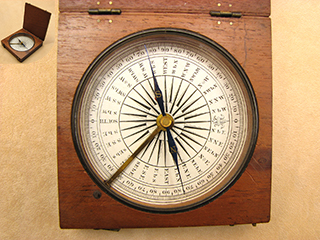
An early Victorian pocket compass set in a mahogany case, with an attractive paper sunburst dial, divided into four 90 degree quadrants and displaying 32 cardinal and inter-cardinal points.
Dating to around 1860, it has its original glass crystal which is retained by a brass bezel, and a stylish blued steel needle, clearly impressed with ‘N’ & ‘S’ gold letters.
As with many wood cased compasses of the period this is unsigned, but the use of concealed hinges attaching the lid to the base, was a feature used predominately by Francis Barker, and it’s very likely this compass was made by Barker.
This is a nice clean compass, with both crystal and dial in good condition and a transit lock activated on lid closure.
A classic 19th century antique, it measures 77mm square x 19mm deep, and the lid is fastened with two elegant 7 shaped brass clasps.
| Select your shipping destination at ORDER page | ||||||
| Price | Code | UK | EU | USA/CAN | AUS/ NZ | RoW |
| £200 | SC2653 | Free | £12 | £18 | £19 | £19 |

Click Image to View Gallery
This is an impressive 19th century brass cased explorers or travellers pocket compass circa 1820, with a separate push on lid.
It has a shapely blued-steel needle engraved N & S for clarity, pivoting on a brass capped bearing over a clean paper dial divided into degrees and also showing 32 cardinal & inter-cardinal points of the compass.
Although unsigned, this is a classic Georgian compass clearly of some quality, with a traditional dial design in good original condition.
A substantial compass weighing just under 300 grams and measuring 75mm in diameter, it's in full working order, and comes in a modern velvet drawstring pouch for protection.
| SOLD | Select your shipping destination at ORDER page | |||||
| Price | Code | UK | EU | USA/CAN | AUS/ NZ | RoW |
| SC2804 | ||||||

Click Image to View Gallery
Dating to last quarter of the 19th century, this is a Mariners brass gimballed compass with a Singers patent floating dial.
Housed in a brass case, it measures 110mm in overall diameter, the bowl at 85mm and stands 65mm high including its separate brass lid.
The floating dial is of the distinctive singer's patent style black and white pattern, printed with the words 'SINGER'S PATENT' next to the South cardinal point, and has a lyre and star motif denoting North, all housed under a clean crystal.
Pivoting on a gemstone bearing and set within a lacquered brass bowl which is free of any knocks or dents, it retains much of its original finish.
A substantial instrument weighing just over 900 grams, it is in full working order, including the gimbal mechanism, this is a quite unique antique compass.
| SOLD | Select your shipping destination at ORDER page | |||||
| Price | Code | UK | EU | USA/CAN | AUS/ NZ | RoW |
| SC2674 | ||||||

Click Image to View Gallery
Although the dial design of this attractive floating dial pocket compass dates to the first half of the 19th century, the use of concealed hinges attaching the lid to the base was a feature used predominately by Francis Barker, and although unsigned it’s very likely this compass was made by Barker during the latter part of the 19th century.
Housed in a polished mahogany case measuring 68mm square and 23mm in thickness with the lid closed, this elegant compass has a distinctive black and white floating card dial with a fleur de lis denoting North, rotating on a brass cap bearing under a clean crystal.
In good cosmetic condition with only minor foxing on the card dial, it's fully working including the original transit lock activated on lid closure, fastened by a brass catch.
| SOLD | Select your shipping destination at ORDER page | |||||
| Price | Code | UK | EU | USA/CAN | AUS/ NZ | RoW |
| SC2788 | ||||||

Click Image to View Gallery
This elegant circular mahogany cased pocket compass dates to the early 19th century, and has a distinctive Regency style starburst floating dial, divided into four 90 degree quadrants with a fleur de lys for North, and pivots on a brass cap bearing under a clear crystal.
The hinged mahogany lid is a snap fit and engages a transit lock when closed.
Unsigned, but quite a rare compass measuring 54mm in diameter by 20mm in depth and weighing just 32 grams, it's in good working order and in excellent condition all round.
| SOLD | Select your shipping destination at ORDER page | |||||
| Price | Code | UK | EU | USA/CAN | AUS/ NZ | RoW |
| SC2704 | ||||||

Click Image to View Gallery
This example of a WW1 era Verner's Pattern MK VI prismatic marching compass made by Charles Baker and signed 'C.BAKER 244 HIGH HOLBORN, LONDON' on the lid.was
Superseded by the more common MK VII shortly after the start of WW1, the MK VI is much less common and unusual to find in such good condition, particularly with its centre paper label completely intact.
An antique military compass in full working order, it has the mother of pearl dial for low light readings, and comes in a 1918 dated leather case with shoulder carry strap.
Not only a sought after compass for a collector, but at just under 260 grams in its case, still practical today for hill walking and similar pursuits.
| SOLD | Select your shipping destination at ORDER page | |||||
| Price | Code | UK | EU | USA/CAN | AUS/ NZ | RoW |
| SC2810 | ||||||

Click Image to View Gallery
The majority of MK V British Army Officers pocket compasses were made during the WW1 period up to 1917, when they were superseded by the MK VI version.
This 1916 example is engraved 'Dennison Birmingham V 116190 1916' with the military arrow on the lid, showing it was issued in to service.
The full hunter nickel case is in very good condition, and the beveled glass crystal covers a Singers Patent style jewelled bearing dial, which has all its original markings intact.
In good working order, it measures 45mm in diameter not including the stem.
| SOLD | Select your shipping destination at ORDER page | |||||
| Price | Code | UK | EU | USA/CAN | AUS/ NZ | RoW |
| SC2807 | ||||||

Click Image to View Gallery
Originally designed by a Canadian geologist named D W Brunton in the late 19th century, the Brunton compass is still very much the first choice of many geologists for field mapping of geological objects.
This particular example is signed 'D.W. BRUNTON'S TRADE MARK REG. PAT. OFF. POCKET TRANSIT. Wm AINSWORTH & SONS DENVER, COLO' and comes with it's original leather case. William Ainsworth & Sons, Denver Colorado were the sole manufacturers of Bruntons Patent when it was granted in 1894.
Brunton compasses are still made today, but this is a relatively rare example by the most renowned maker of this type and the serial number of '44326' for this compass indicates this would have likely been made around 1948.
Weighing just over 330 grams in its case, it measures 75mm x 70mm by 30mm in height and is in very good condition with a clean mirror and in full working order.
| SOLD | Select your shipping destination at ORDER page | |||||
| Price | Code | UK | EU | USA/CAN | AUS/ NZ | RoW |
| SC2801 | ||||||

Click Image to View Gallery
Described as the 'PROSPECTING COMPASS' in the Francis Barker catalogues of the early 20th century, this example although carrying the 1906 Barker patent number 12777, is engraved 'NEGRETTI & ZAMBRA LONDON' on the underside, suggesting it may have been made by Negretti & Zambra under license, or rebranded for them by Barker.
The brass snap hunter case houses a flat bar needle, which freely pivots on an agate bearing inside a raised 360 degree graduated ring.
Advertised as suitable for Prospectors and others, it has a hinged lid which incorporates a domed magnifying glass, and was used by prospectors for close inspection of precious metals, as well as a burning glass when looking to start a fire without flint.
In good working order with a strong hinge and manual transit lock, the compass body retains virtually all of its original black finish and comes in its original leather case.
Signed 'NEGRETTI & ZAMBRA LONDON' in gold lettering on the inside flap (see photo) as well as 'F.S.B.' on the front (possibly the initials of its first owner), the case is in sound condition with all stitching intact.
Weighing just under 100 grams in its case and measuring 46mm in diameter by 18mm deep, this is a rare antique compass of an unusual design.

| SOLD | Select your shipping destination at ORDER page | |||||
| Price | Code | UK | EU | USA/CAN | AUS/ NZ | RoW |
| SC2716 | ||||||

Click Image to View Gallery
Dating to the post WW2 period, this bridge compass clinometer was made by J H Steward, and is signed 'J. H. STEWARD Ltd, 406 Strand, London' on the underside.
Mainly used by surveyors, it also incorporates a pendulous arm for measuring rise and fall on an inches per yard scale and the black compass needle pivots on a gemstone bearing above a decorative dial with a 360 degree scale.
Measuring 75mm in diameter and weighing just over 250g in its original case, the compass is in full working order including the transit lock which is activated by a brass knob on the side.
| SOLD | Select your shipping destination at ORDER page | |||||
| Price | Code | UK | EU | USA/CAN | AUS/ NZ | RoW |
| SC2766 | ||||||

Click Image to View Gallery
Although unsigned, this impressive late Victorian hunter cased pocket compass has an attractive mother of pearl black & white dial, similar in design to the Singers patent pattern, and pivoting on a gemstone bearing.
Dating to around 1900, it's housed in a brass case free from any dents with the main cardinal points painted in red on the underside of the crystal.
Measuring 55mm in diameter not including the bow and weighing just under 150 grams, the brass body is also in good original condition with no dents.
A sturdy compass in full working order, there is also a transit lock activated by lid closure to secure the dial when not in use.
| SOLD | Select your shipping destination at ORDER page | |||||
| Price | Code | UK | EU | USA/CAN | AUS/ NZ | RoW |
| SC2721 | ||||||

Click Image to View Gallery
A stylish example of an Edwardian hunter cased pocket compass with a cross bar needle pivoting on a gemstone bearing over a decorative silvered aluminium dial signed 'Dollond London'.
Dating to around 1910, its in very good clean condition with a clear undamaged crystal on which the main cardinal points are painted in red on the underside.
Measuring 44 mm in diameter not including the bow and weighing just under 80 grams, this is a sturdy brass compass in full working order, including the transit lock which is activated by lid closure.
| SOLD | Select your shipping destination at ORDER page | |||||
| Price | Code | UK | EU | USA/CAN | AUS/ NZ | RoW |
| SC2781 | ||||||

Click Image to View Gallery
This elegant brass cased explorer’s style compass with a separate push fit lid dates to the second half of the 19th century.
It's an unsigned example with an English cross bar needle, pivoting on a jewelled bearing above a traditional dial, denoting 32 cardinal and inter cardinal points under a clean undamaged crystal.
In good original uncleaned condition, the brass case is free of any dents as is the matching original lid, both for protecting the glass crystal and engaging the built in transit lock.
Measuring 60mm across the glass by 17mm deep and weighing 115 grams, it's in good working order and comes with a modern velvet drawstring pouch for added protection.
| SOLD | Select your shipping destination at ORDER page | |||||
| Price | Code | UK | EU | USA/CAN | AUS/ NZ | RoW |
| SC2682 | ||||||

Click Image to View Gallery
This is an impressive circular desk top compass measuring 6¼" (160mm) in diameter, and made by Francis Barker & Son carrying their small but familiar Trade Mark London, arranged in a triangle with an inset logo reading B&S.
The attractive paper dial is in clean condition and is set under a jewelled steel needle measuring 4½" (115mm) length, the glass crystal is also in good condition with only light surface scratches.
Weighing 260 grams and dating to around 1890, this oak cased compass was probably intended for use as an interesting desk ornament, a purpose it would still fulfil today.
In full working order, it finds North well and takes a little time to settle, a quite splendid Victorian compass with rare novelty value.
| SOLD | Select your shipping destination at ORDER page | |||||
| Price | Code | UK | EU | USA/CAN | AUS/ NZ | RoW |
| SC2777 | ||||||

Click Image to View Gallery
Although not signed by any maker, this full hunter cased pocket compass was probably made by Francis Barker in the pre WW2 period, and is the MK VII version, which was the last model of the pocket watch style designs that were developed during WW1 for British Army Officers.
In very good condition, the dent free case retains all its nickel plating and has a clean undamaged crystal, under which the floating dial pivots on a gemstone bearing.
All in good working order, it measures 45mm in diameter and weighs just over 60 grams.
| SOLD | Select your shipping destination at ORDER page | |||||
| Price | Code | UK | EU | USA/CAN | AUS/ NZ | RoW |
| SC2776 | ||||||

Click Image to View Gallery
This full hunter cased pocket compass is engraved 'CHADBURNS LTD, LIVERPOOL' on the underside and dates to the early 20th century.
Formed in 1818 by William Chadburn and David Wright, the business was taken over by Williams' three sons by the 1840s. The firm also exhibited at The Great Exhibition in 1851 and gained prominence by specialising in ships telegraphs at the end of the century.
The cross bar needle pivots on a gemstone bearing for reduced friction, above a frosted aluminium dial with 8 cardinal points and a 360 degree outer scale, all set under a clean bevelled edge crystal.
The nickel case is in good clean condition, although there are a couple of minor dings on the lid (see photo) and what appears to be a modern replacement screw in the frame edge, neither of which affect the function.
In good working order,
the snap fit lid also engages the transit lock to hold the needle in place when on the move.
The compass measures 45mm in diameter, not including the stem.
| SOLD | Select your shipping destination at ORDER page | |||||
| Price | Code | UK | EU | USA/CAN | AUS/ NZ | RoW |
| SC2780 | ||||||

Click Image to View Gallery
Dating to the last quarter of the 19th century, this is a rare brass floating dial pocket compass by Francis Barker.
The dial bears the markings 'Trade Mark London', arranged in a triangle below the North fleur de lis, contained within is a combination of 3 letters and one symbol, F B and S. These are superimposed over each other to form the logo of Francis Barker & Son. The S in this instance is reversed, indicating this was made after the death of Francis Barker in 1875.
Housed in a brass case with some minor dings on the base, it includes a separate push fit lid measuring 68mm in overall diameter, and stands 40mm high with the lid on.
The distinctive compass card pivots on a gemstone bearing finding North easily, on the underside are etched the letters 'E I', (see photo) possibly the initials of a previous owner.
This is clearly a quality instrument weighing just under 170 grams and made by one of the more prominent makers of the day.

| SOLD | Select your shipping destination at ORDER page | |||||
| Price | Code | UK | EU | USA/CAN | AUS/ NZ | RoW |
| SC2710 | ||||||

Click Image to View Gallery
An iconic WW1 British Army Officers MK VI pocket compass, engraved 'Dennison Birmingham VI 59705 1917' with the military arrow on the lid, showing it was issued in to service.
Housed in a full hunter nickel case, the beveled glass crystal covers an attractive jewelled bearing floating dial, which has all its original markings intact.
In excellent cosmetic condition and fully working, it measures 45mm in diameter not including the stem.
A fine example from the most prolific maker of this style of compass.
| SOLD | Select your shipping destination at ORDER page | |||||
| Price | Code | UK | EU | USA/CAN | AUS/ NZ | RoW |
| SC2768 | ||||||

Click Image to View Gallery
Dating to the late 19th century, this pocket compass is signed 'TROUGHTON & SIMMS LONDON' on the brass underside. The partnership was formed by William Simms and Edward Troughton in 1826, and their instruments were highly regarded for both accuracy and reliability.
The business continued in to the 20th century when they were taken over by Vickers Instruments Ltd.
Its Singers Patent style high contrast design aluminium dial was intended to be much easier to read in low light than other conventional compasses of the time, and pivots on a gemstone bearing for reduced friction.
The clean dial sits under a thick chip free bevelled glass and finds North easily, with a manual transit lock activated by pushing the bow stem in, keeping the dial in place when not in use, please note the end stop on the stem is a later replacement.
The brass body measures 60mm in diameter not including the bow, and whilst it has some light surface scratches on the underside, it's otherwise in good condition with no dents to the body and is accompanied by its original leather case.
Weighing just over 180 grams in its case, and in good working order, this is a relatively rare compass from a renowned instrument maker.
| SOLD | Select your shipping destination at ORDER page | |||||
| Price | Code | UK | EU | USA/CAN | AUS/ NZ | RoW |
| SC2715 | ||||||

Click Image to View Gallery
Dating to circa 1820, this impressive Georgian travellers compass is set in a hinged mahogany case measuring 65mm square.
Complimented by the small hand made brass hinges and fastened with a 7 shaped brass clasp, the paper compass rose divides into four 90 degree quadrants showing all the points of the compass with a fleur de lys for North, and is in very good condition for a 200 year old compass.
The elegant blued steel needle is also engraved with 'N' & 'S' faded letters and sits under a clean glass crystal.
Inside lid there is some inked writing which reads 24 1/2 West above a large 'RW', but the top line is too faded to make out the letters with any certainty.
In good working order, the needle is locked in position for transit by a brass pin which comes into play when the lid is closed.
A genuine antique compass with a traditional design, the mahogany case is free of any splits or cracks.
| SOLD | Select your shipping destination at ORDER page | |||||
| Price | Code | UK | EU | USA/CAN | AUS/ NZ | RoW |
| SC2749 | ||||||

Click Image to View Gallery
This impressive brass surveying compass was made during the second half of the 19th century by James Parkes & Son of 5 St. Mary's Row, Birmingham, as indicated by their custom trademark logo of an eye with brow around the centre of the dial, which could also suggest a masonic connection.
It has two foldable sight vanes set above a silvered dial and an English cross bar steel needle that pivots on a gemstone bearing. The dual scale dial spans the full 360 degrees on the stepped outer chapter ring and four 90 degree quadrants on the base.
Both sights are intact and fold flat, with a side lever operated transit lock to hold the needle in place when not in use, and the compass sits in a purpose made mahogany case designed to also store the tripod adaptor in situ with the compass.
In very good condition, measuring 80mm in diameter and weighing 160 grams (290 grams with the case), it's in full working order.
| SOLD | Select your shipping destination at ORDER page | |||||
| Price | Code | UK | EU | USA/CAN | AUS/ NZ | RoW |
| SC2708 | ||||||

Click Image to View Gallery
Dating to the turn of the 20th century, this is a large example of a desktop mahogany cased compass measuring 8½" square.
Signed 'F. BARKER & SON, MAKERS LONDON' on the dial, it also has the Trade Mark London logo above the North fleur de lis, which has a combination of 3 letters and one symbol, F B & S. These are superimposed over each other to form the logo of Francis Barker & Son, and the S is reversed, showing this was made after the death of Francis Barker in 1875.
The black and white sunburst compass dial is in good, clean condition, has 32 cardinal and inter cardinal points with a full 360 degree scale, and the black and steel needle pivots on a gemstone bearing under a clean glass crystal.
Measuring 8½"by 8½" by 1½" (215mm x 215mm x 40mm), a substantial compass in very good condition, with only some light scratches on the the lid, which fastens shut with two brass clasps and also activates a transit lock.
In full working order finding North easily and weighing 870 grams, an impressive antique compass from a prestigious maker.
| SOLD | Select your shipping destination at ORDER page | |||||
| Price | Code | UK | EU | USA/CAN | AUS/ NZ | RoW |
| SC2703 | ||||||

Click Image to View Gallery
This unusual compass with foldable sight vanes is set in a very attractive mahogany case, and fastened by twin brass clasps.
The English cross bar needle pivots on a gemstone bearing above the silvered dial with an upper 360 degree chapter ring under a clean, chip free glass crystal.
Dating to the latter part of the 19th century, like many wood cased compasses of the period it is unsigned, but it is a quality piece so likely to have been made by one of the major makers of the time, probably Francis Barker.
In working order with a lid activated transit lock, this compass is in very good condition as can be seen by the Photos.
A less common design for wood cased pocket compass, it weighs 160 grams and measures 80mm square by 21mm deep.
| SOLD | Select your shipping destination at ORDER page | |||||
| Price | Code | UK | EU | USA/CAN | AUS/ NZ | RoW |
| SC2594 | ||||||

Click Image to View Gallery
An iconic WW1 British Army Officers MK VI pocket compass, engraved 'Dennison Birmingham VI 81684 1918' with the military arrow on the lid, showing it was issued in to service.
Housed in a full hunter nickel case , the beveled glass crystal covers an attractive jewelled bearing floating dial, which has all its original markings intact.
In very good cosmetic condition and fully working, although the nickel case does have some very minor dings on the lid which are quite hard to see in the Photos.
Measuring 45mm in diameter not including the stem, a fine example from the most prolific maker of this style of compass
| SOLD | Select your shipping destination at ORDER page | |||||
| Price | Code | UK | EU | USA/CAN | AUS/ NZ | RoW |
| SC2734 | ||||||

Click Image to View Gallery
This British Army Officers MK V pocket compass was made by Negretti & Zambra, and although the lid engraving is worn around the serial number and date, it appears to read 'NEGRETTI & ZAMBRA LONDON V 1636 1908'. There is a military arrow on the lid and another on the underside, showing it was issued in to service.
The full hunter case is not the more common Dennison case, and the nickel plating on the underside has been polished back to brass, but is in dent free condition and retains all its nickel plating on the rest of the case, with some minor loss inside the lid.
In full working order including the transit lock, the bevelled glass crystal covers the distinctive Singers patent style black & white floating dial, which is mounted on a jewelled brass bearing for reduced friction on the pivot point.
It measures 45mm in diameter,not including the stem.
Negretti & Zambra did not make very many of this type of compass compared to Dennison, who made the bulk of those issued during WW1, so relatively rare in collecting circles.
| SOLD | Select your shipping destination at ORDER page | |||||
| Price | Code | UK | EU | USA/CAN | AUS/ NZ | RoW |
| SC2738 | ||||||

Click Image to View Gallery
This impressive mid 19th century Mariners small boat compass is gimbal mounted in its original jointed oak box, but has a later replacement sliding lid, and measures 5¼" square by 3½" deep, with a compass bowl diameter of 3".
The traditional floating dry card dial pivots on a gemstone bearing with a distinctive fleur de lis denoting North, and the dial divided into 90 degree quadrants displaying 32 cardinal and inter-cardinal points.
In good condition all round, the dial is clean with a clear glass crystal and the brass bowl retains much of its original lacquer.
A substantial instrument weighing just under 700 grams, not only in good working order, but also a nice decorative antique which displays very well.
| SOLD | Select your shipping destination at ORDER page | |||||
| Price | Code | UK | EU | USA/CAN | AUS/ NZ | RoW |
| SC2712 | ||||||

Click Image to View Gallery
Dating to the latter part of the 19th century, this Victorian pocket compass is signed on the dial 'DOLLOND LONDON' around the pivot and housed in a nickel plated hunter case.
Set under a domed crystal, it has an English cross bar cross bar needle pivoting on a gemstone bearing for reduced friction, above a traditional paper dial which does have a small scuff under the North point, but is otherwise clean.
Although there is some minor plating loss in places, the case is free of any dents and is in good working order.
| SOLD | Select your shipping destination at ORDER page | |||||
| Price | Code | UK | EU | USA/CAN | AUS/ NZ | RoW |
| SC2739 | ||||||

Click Image to View Gallery
An unusual example of a Francis Barker & Son 19th century pocket compass, with a 'B & S' (for Barker & Sons) impressed on the metal rim.
Direction is indicated by an English cross bar needle which pivots on a brass cap bearing, above a paper compass dial divided into four 90 degree quadrants showing 16 cardinal and intercardinal points with a fleur de lys for North, all housed under a clean glass crystal.
The body is fixed in place inside a leather outer case with navy blue velvet interior, which is in good condition with a sound hinge and the lid is held shut by a hook shaped clasp to protect the glass when not in use.
Weighing just 30 grams in its case and measuring 46mm in diameter by 17mm deep, its in good working order.
| SOLD | Select your shipping destination at ORDER page | |||||
| Price | Code | UK | EU | USA/CAN | AUS/ NZ | RoW |
| SC2717 | ||||||

Click Image to View Gallery
Although Stanley was a well known maker of scientific instruments, not many WW1 British Army Officers pocket compasses were made by him.
This particular compass is signed 'Stanley, London, V, 113994, 1917' with the military arrow engraved on the lid, it's in good working order and a very collectable compass.
Housed in a Dennison nickel case, the attractive Singers patent style black & white dial with all of its original markings complete, pivots on a gemstone bearing and sits under a glass crystal.
Measuring approx 45mm diameter, this is a nice example of the iconic WW1 compasses, and with so many reproduction instruments bearing the name Stanley London on the internet, it's a treat to find one of the few genuine items with the MK V design.
| SOLD | Select your shipping destination at ORDER page | |||||
| Price | Code | UK | EU | USA/CAN | AUS/ NZ | RoW |
| SC2680 | ||||||

Click Image to View Gallery
This early 20th century prismatic clinometer consists of a yellow card dial measuring inches per yard, with folding sight vane and designed to be viewed in the vertical plane.
Although unsigned, it's a quality instrument in very good condition with the body retaining almost all of its original black finish, and comes in its fitted leather case which is also in good condition, with all stitching intact.
In full working order, this type of instrument was often used by civil engineers and also artillery regiments in the British army for range calculations and targeting heavy guns.
A well made instrument, it weighs 270 grams including the case and measures 72mm in diameter across the main body.
| SOLD | Select your shipping destination at ORDER page | |||||
| Price | Code | UK | EU | USA/CAN | AUS/ NZ | RoW |
| SC2660 | ||||||

Click Image to View Gallery
This Angle of Sight instrument is dual purpose in that it incorporates a prismatic compass, consisting of a silvered ring dial with a 360 degree scale, and a 1 to 1 clinometer scale visible in the vertical plane. These two functions are controlled by the brass button on the side which locks the compass when using the clinometer, and vice versa.
(A similar model appears in a 1919 Francis Barker catalogue, where its referred to as a ‘combined altitude instrument and prismatic compass’)
Constructed from bronzed brass, its engraved 'J. H STEWARD LTD 406 & 457, STRAND LONDON'.
In full working order, this type of instrument was often used by civil engineers and also artillery regiments in the British army for range calculations and targeting heavy guns.
In very good condition including its leather case, this is a substantial instrument, which weighs just under 450 grams including the case, and measures 70mm in diameter across the main body.
| SOLD | Select your shipping destination at ORDER page | |||||
| Price | Code | UK | EU | USA/CAN | AUS/ NZ | RoW |
| SC2676 | ||||||

Click Image to View Gallery
A stylish example of an Edwardian hunter cased pocket compass with an English cross bar needle pivoting over a decorative silvered aluminium dial.
Dating to around 1910, its in very good clean condition with a clear undamaged crystal on which the main cardinal points are painted in red on the underside.
The brass case is also retains much of its original black finish and is dent free.
Measuring 52mm in diameter not including the bow and weighing 150 grams, this is a sturdy compass in full working order including the transit lock which is activated by lid closure.
| SOLD | Select your shipping destination at ORDER page | |||||
| Price | Code | UK | EU | USA/CAN | AUS/ NZ | RoW |
| SC2652 | ||||||

Click Image to View Gallery
This impressive mid 19th century Mariners small boat compass is gimbal mounted in its original jointed oak box, but has a later added sliding lid, and measures 6" square by 4¾" deep, with a compass bowl diameter of 4".
The traditional floating dry card dial pivots on a gemstone bearing with a distinctive fleur de lis denoting North, and interestingly a subtle logo around the East cardinal point, which may be an indication of a particular maker as this is unsigned.
In good condition all round, the dial is clean with a clear glass crystal and the brass bowl retains virtually all its original lacquer, although there is a minor hairline split in one area which does not affect the function and is only visible with the bowl upturned, see photo.
A substantial instrument weighing just over 1.2kg, not only in good working order, but also a nice decorative antique which displays very well.
| SOLD | Select your shipping destination at ORDER page | |||||
| Price | Code | UK | EU | USA/CAN | AUS/ NZ | RoW |
| SC2689 | ||||||

Click Image to View Gallery
Dating to the first half of the 19th century circa 1840, this is a Mariners brass gimballed pocket compass.
Housed in a brass case with a separate brass lid, it measures 75mm in overall diameter, and stands 45mm high.
In good condition, with a distinctive black and white sunburst dial, the compass card pivots on a gemstone bearing and sits in a 60mm diameter lacquered brass bowl.
Although unsigned this is clearly a quality instrument weighing just over 400 grams, and probably made by one of the more prominent makers of the day.
In working order and in original uncleaned condition, quite a rare antique compass.
| SOLD | Select your shipping destination at ORDER page | |||||
| Price | Code | UK | EU | USA/CAN | AUS/ NZ | RoW |
| SC2608 | ||||||

Click Image to View Gallery
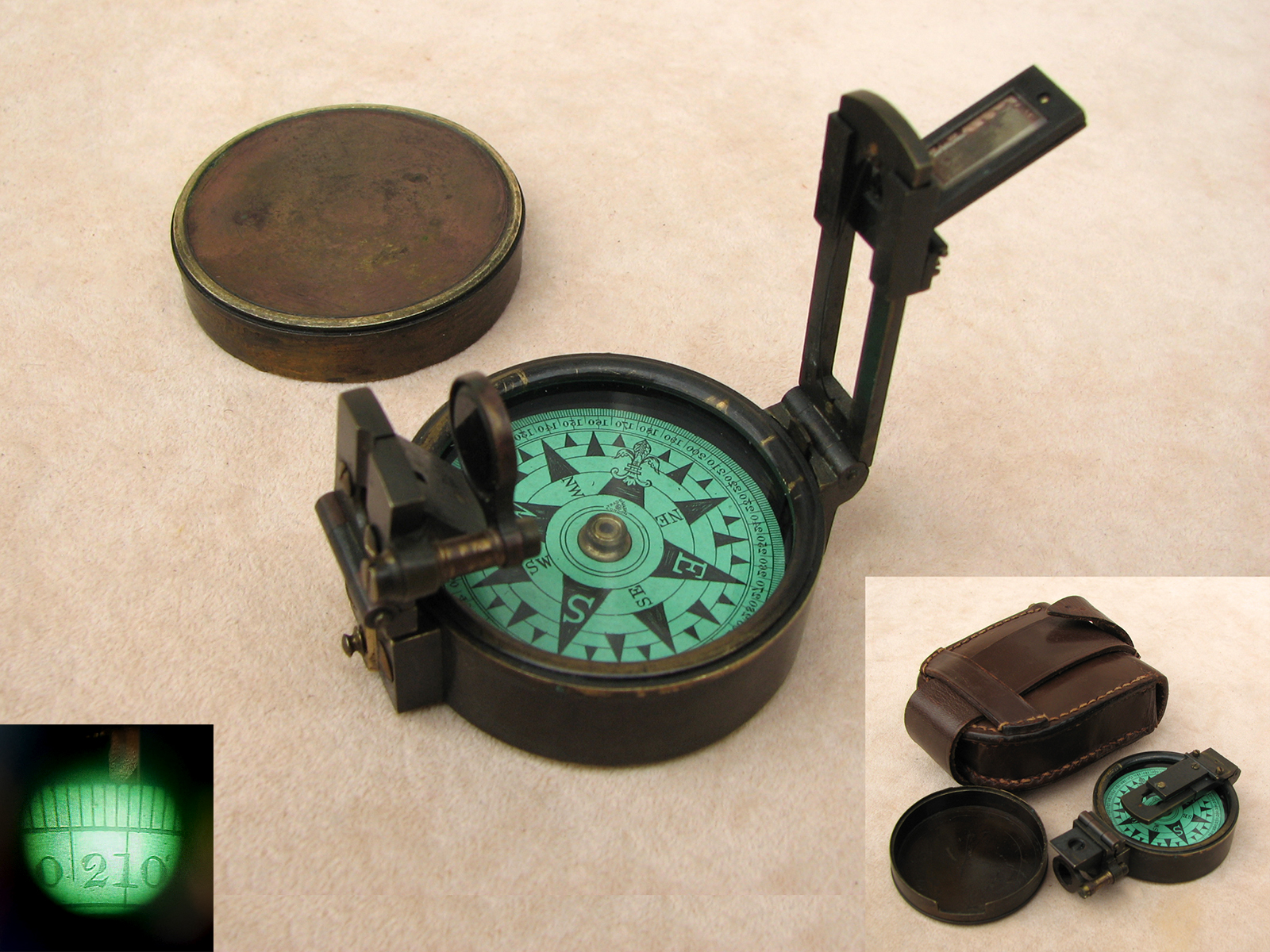
This visually impressive anodised brass prismatic pocket compass with a separate push fit lid was made by Francis Barker & Son around 1880, as evidenced by the small FBS logo within the Trademark London triangle and printed on the card dial just below the North cardinal point.
It has a distinctive black and green floating card dial which pivots on a gemstone under a clean glass crystal. The brass case with a push fit lid is in good condition, having no dents or damage and is smaller than usual for these prismatic compasses.
The prism shows a clear image of the dial (see photo) as well as a rotating arm anti glare filter, and though a little tarnished, the sighting vane retains its original mirror.
In full working order including the transit lock and manual finger brake, despite its small size this is a quality instrument measuring just 45mm diameter and 22mm deep with the lid. In good cosmetic condition, it comes with a later snug fitting stitched leather case for added protection.
Combined, the compass and case together weigh just under 150 grams, and serves as a very rare miniature version of the much larger green card prismatics of the period. Please note there is some light scribing of hand drawn compass points inside the lid, see photo.
| SOLD | Select your shipping destination at ORDER page | |||||
| Price | Code | UK | EU | USA/CAN | AUS/ NZ | RoW |
| SC2672 | ||||||

Click Image to View Gallery
This is an elegant Victorian brass cased travellers compass with a very clean traditional dial, denoting 32 cardinal and inter cardinal points, under a clean crystal.
The shapely blued steel needle has N & S engraved in gold lettering for clarity, and pivots on a brass bearing.
Although missing its lid, this is a fine antique compass dating to the latter part of the 19th century, it has the classic compass rose design with a distinctive Fleur de Lis crest denoting North.
In good working order, and measuring 55mm diameter by 11mm deep, it weighs just under 60 grams, and comes with a modern velvet drawstring pouch for added protection.
| SOLD | Select your shipping destination at ORDER page | |||||
| Price | Code | UK | EU | USA/CAN | AUS/ NZ | RoW |
| SC2684 | ||||||

Click Image to View Gallery
This French 19th century mahogany cased compass is signed 'BARABAN, DUPRESSOIR SUCCr, 175 RUE St HONORE, PARIS' on the dial.
It has a steel needle which pivots on a gemstone bearing and a folding sight arm which is used in conjunction with the mirror in the lid.
There's also a centimeter rule on the outside edge of the base and a functioning transit lock activated by lid closure.
In very good condition and fully working, it measures 80mm square by 25mm deep.
| SOLD | Select your shipping destination at ORDER page | |||||
| Price | Code | UK | EU | USA/CAN | AUS/ NZ | RoW |
| SC2615 | ||||||

Click Image to View Gallery
Although unsigned this mid 19th century brass prismatic sighting compass was likely made by Elliott Brothers.
A sliding hinged mirror is attached to the sight vanes for taking readings of forward and reverse reference points simultaneously and can flip 90 degrees in either direction along the vane on the users preference.
Attached to the viewfinder are also fold-away red and green filters to mask glare when facing the sun.
The fitted lid inverted attaches to the compass base to double as a raised stand for taking bearings.
In full working order including the transit lock which is activated by the folding sight vane, the cosmetic condition is good with no dings or dents, and a clean crystal under which the floating green card dial pivots on a gemstone bearing.
A quality antique instrument measuring 72mm in diameter it comes in its original leather case which is also in good sound condition and there is a pen mark of '6B' on one side.
The compass and case combined weigh just under 450 grams.
| SOLD | Select your shipping destination at ORDER page | |||||
| Price | Code | UK | EU | USA/CAN | AUS/ NZ | RoW |
| SC2696 | ||||||

Click Image to View Gallery
Dating to the early 1800's and complimented by the small triangular hand made hinges, this mahogany cased pocket compass has a distinctive Regency starburst floating dial, divided into four 90 degree quadrants with a fleur de lys for North, and pivots on a brass cap bearing under a clear crystal.
Although unsigned, it's an elegant compass in very good condition, and in full working order, with a transit lock activated by lid closure.
Measuring 65mm square by 23mm deep and weighing just 65 grams, a nice clean example of an early 19th century antique compass, which interestingly has some old hand written text on the underside of the card dial.
| SOLD | Select your shipping destination at ORDER page | |||||
| Price | Code | UK | EU | USA/CAN | AUS/ NZ | RoW |
| SC2695 | ||||||

Click Image to View Gallery
This is a fine example of a mid 19th century mariners compass mounted on gimbals in a mahogany case with a sliding bevelled lid.
Usually these types of compass are quite large, but this particular example, is only 4" (100mm) square and 3¼" (84mm) in height, with the compass bowl being just 65mm in diameter, making it a more compact and relatively uncommon compass.
The compass floating card dial has 32 cardinal and inter cardinal points with a distinctive Fleur de lis crest denoting North and pivots on a gemstone bearing, set within a lacquered brass compass bowl that has some age tarnishing, but no knocks or dents.
The mahogany case has early dovetail joints and is in good condition, although it has had a small section of the right hand top outer edge replaced in the past.
Dating to circa 1850, this is a robust little compass weighing just 382 grams and is in good working order with a clean dial and glass crystal.
| SOLD | Select your shipping destination at ORDER page | |||||
| Price | Code | UK | EU | USA/CAN | AUS/ NZ | RoW |
| SC2659 | ||||||

Click Image to View Gallery
This bronzed brass green card prismatic sighting compass is signed 'STANLEY. GṬ TURNSTILE, HOLBORN, LONDON'.
William Ford Stanley was a British engineer and inventor who made significant contributions to the development of electric lighting and power distribution systems in the late 19th and early 20th centuries.
This would have been a precision instrument of high quality in its time, and likely used for surveying by both military and civilian personnel. The address on the dial would date the compass to the latter part of the 19th century, as Stanley operated out of this location from that time.
In very good cosmetic condition, the floating green card dial pivots on a gemstone bearing under a clean crystal, and comes in its original leather case, which has seen some extensive repairs but is still robust.
A quality antique instrument measuring 70mm in diameter with the compass and case together weighing just under 320 grams.
A genuine Stanley antique compass not to be confused with the many repros sadly carrying that name!
| SOLD | Select your shipping destination at ORDER page | |||||
| Price | Code | UK | EU | USA/CAN | AUS/ NZ | RoW |
| SC2679 | ||||||
Click Image to View Gallery
Considered to be the best hand held military compass in the world, this Francis Barker M-73 prismatic compass is cosmetically in mint condition with no paint loss, as can be seen from the Photos.
The M-73 is still in use by many military forces around the world including NATO, and is made from brass/aluminium.
This particular example is the liquid filled Mils version with a precision sapphire bearing, and comes with a stitched leather case and shoulder strap for protection in the field.
A civilian purchase numbered 23120, it clearly has had very little use and is in good working order with no bubbles in the liquid, although due to its age the tritium lights are no longer active.
You really can't get a more accurate compass, and this is perfect for anyone involved in outdoor pursuits who needs a precision compass.
Weighing just 320 grams in its case, used models are rarely available in such good condition.
| SOLD | Select your shipping destination at ORDER page | |||||
| Price | Code | UK | EU | USA/CAN | AUS/ NZ | RoW |
| SC2671 | ||||||
Click Image to View Gallery
Dating to the post WW2 period, this unsigned bridge compass with clinometer was made by Francis Barker & Son who produced these on a wholesale basis for others to retail.
Mainly used by surveyors, it also incorporates a pendulous arm for measuring rise and fall on an inches per yard scale and the black compass needle pivots on a gemstone bearing above a decorative dial with a 360 degree scale.
Measuring 75mm in diameter, the compass is in full working order including the transit lock which is activated by a brass knob on the side, and comes in its original brown leather case which is also in very good condition.
| SOLD | Select your shipping destination at ORDER page | |||||
| Price | Code | UK | EU | USA/CAN | AUS/ NZ | RoW |
| SC2666 | ||||||
Click Image to View Gallery
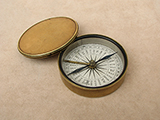
This is an elegant Victorian brass cased travellers pocket compass with a classic compass rose design, showing cardinal and inter cardinal points, and a distinctive Fleur de Lis crest denoting North.
Direction is indicated by a stylish blued steel needle engraved N & S in gold lettering for clarity, which pivots on a brass capped bearing under a clean undamaged crystal.
The brass case is in good original condition with its separate push fit brass lid, both for protecting the glass crystal and engaging the built in transit lock.
A fine antique compass dating to the mid 19th century, in full working order and measuring 60mm diameter by 15mm deep including the lid, it weighs 100 grams and comes with a modern velvet drawstring pouch for added protection.
| SOLD | Select your shipping destination at ORDER page | |||||
| Price | Code | UK | EU | USA/CAN | AUS/ NZ | RoW |
| SC2639 | ||||||
Click Image to View Gallery
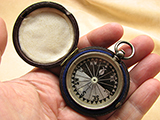
This distinctive pocket compass has the classic black & white Singers patent design on a mother of pearl dial and carries a serial number 23606, showing it was made sometime between 1861 and before 1868 when Samuel Berry Singer's patent lapsed.
Floating on a gemstone pivot in a nickel case and housed under a bevelled glass crystal, it measures 44mm diameter overall, and 12 mm deep, and has a transit lock activated by a push button on the stem.
In full working order, a traditional antique compass in very good condition, it comes in its original burgundy velvet lined, leather covered outer case.
| SOLD | Select your shipping destination at ORDER page | |||||
| Price | Code | UK | EU | USA/CAN | AUS/ NZ | RoW |
| SC2657 | ||||||
Click Image to View Gallery
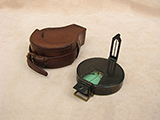
James Joseph Hicks worked in London from 1861, making and selling a wide variety of instruments, becoming one of the most prolific makers in the country during the 19th century.
This brass cased green card dial prismatic compass reads 'J. HICKS. 8. HATTON GARDEN. LONDON' and is in good cosmetic condition with a clean crystal under which the dial pivots on a gemstone bearing.
The compass retains most of its finish, aside from a small area on the side of the frame, and measures 70mm diameter and comes with a leather case, which is in good condition
Dating to the late Victorian period, it's in good working order including the transit lock activated by the folding sight vane.
The compass and case together weigh just under 250 grams.
| SOLD | Select your shipping destination at ORDER page | |||||
| Price | Code | UK | EU | USA/CAN | AUS/ NZ | RoW |
| SC2598 | ||||||
Click Image to View Gallery
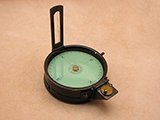
This mid 19th century brass green card prismatic sighting compass is signed 'TROUGHTON & SIMMS, LONDON' and the design is based on the Schmalcalders patent which expired in 1826.
This particular example was previously owned by a member of the the Geological Survey of Scotland which was formed in 1869 and has their logo 'G.S' with a crown symbol engraved on the lid.
A partnership formed by William Simms and Edward Troughton in 1826, their instruments were highly regarded for accuracy and reliability, and were later appointed instrument makers to the Board of Ordnance, London.
In full working order including the transit lock activated by a side lever, and a brass swivel dust cover protecting the prism when not in use, it also has a finger brake to settle the dial quickly.
When closed the sight vane folds flat under the fitted lid, and also doubles as a stand when attached to the base.
In good cosmetic condition, the floating green card dial pivots on a gemstone bearing under a clean crystal, and comes in its original leather case with carry strap, which is also in good condition with unbroken stitching.
A quality antique instrument measuring 70mm in diameter, and with its case weighs just over 400 grams.
This compass comes from part of a small group of scientific instruments purchased together from a collection that belonged to a member of the Geological Survey of Scotland.
See also items SC2643 And SC2624
| SOLD | Select your shipping destination at ORDER page | |||||
| Price | Code | UK | EU | USA/CAN | AUS/ NZ | RoW |
| SC2642 | ||||||
Click Image to View Gallery
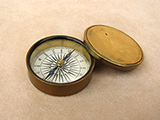
A small Victorian compass dating to the mid 19th century, it has the classic compass rose design with a Fleur de Lis crest denoting North, and its original brass push fit lid.
Although unsigned this compass is a piece of some quality and has a shapely blued steel needle engraved 'N' & 'S' in gold letters for clarity.
The paper dial is in excellent condition with no tears or lifting and is protected by a clean crystal.
In full working order and in very good condition this diminutive but elegant antique compass, measures just 17mm diameter and 10mm deep including the lid.
| SOLD | Select your shipping destination at ORDER page | |||||
| Price | Code | UK | EU | USA/CAN | AUS/ NZ | RoW |
| SC2628 | ||||||
Click Image to View Gallery
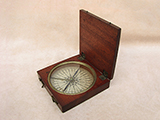
Dating to circa 1820, this impressive Georgian traveller's compass is set in a hinged mahogany case measuring 90mm square.
Complimented by the small hand made brass hinges and fastened with a pair of 7 shaped brass clasps, the paper compass rose divides into four 90 degree quadrants showing all the points of the compass with a fleur de lys for North, and is in very clean condition for a 200 year old compass.
The elegant blued steel needle is also engraved with 'N' & 'S' letters and sits under a clean glass crystal.
In good working order, the needle is locked in position for transit by a brass pin which comes into play when the lid is closed.
A genuine antique compass with a traditional design, it has the name of a former owner 'R. FINLAY' engraved on one edge of the lid.
| SOLD | Select your shipping destination at ORDER page | |||||
| Price | Code | UK | EU | USA/CAN | AUS/ NZ | RoW |
| SC2611 | ||||||
Click Image to View Gallery
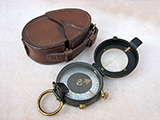
This is a WW1 Verner's pattern MK VII prismatic marching compass dated 1914 with leather case.
Engraved on the underside is 'H. HUGHES & SON Ltd, No 11033, 1914' and stamped with the British Army War department arrow.
In very good condition all round, with a Mother of Pearl dial for low light reading, it has a gemstone bearing for reduced friction and there is a manual transit lock.
The brass case is dent free retaining its anti slip rubber ring on the underside, the leather case is also in good condition.
In good working order, a genuine piece of Britain's WW1 history.
| SOLD | Select your shipping destination at ORDER page | |||||
| Price | Code | UK | EU | USA/CAN | AUS/ NZ | RoW |
| SC2617 | ||||||
Click Image to View Gallery
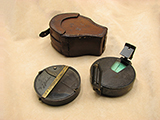
A fine example of a prismatic compass and Watkin's clinometer combination, made by James Joseph Hicks in the second half of the 19th century, the clinometer can be detached from its bayonet fixings for independent use.
Housed in a fitted leather case stamped H.C. and impressed with what appears to be a fluer de lis, both compass and clinometer are engraved W. J Johnston, who may be William John Johnston, a professor of mathematics at Aberystwyth University in the 1880's.
Weighing just over 400 grams in the case, both compass and clinometer are in very good condition and fully functional.
| SOLD | Select your shipping destination at ORDER page | |||||
| Price | Code | UK | EU | USA/CAN | AUS/ NZ | RoW |
| SC2627 | ||||||
Click Image to View Gallery
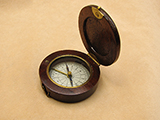
This elegant circular mahogany compass dates to the mid 19th century, and the dial reads 'W. & F. NEWTON. 3 FLEET ST LONDON', which refers to cousins William and Frederick Newton, who formed the partnership of W & F Newton in 1851.
William left the business in 1856 which was subsequently renamed Newton & Co, the company lasting into the 1950s before being acquired by the Victor Corporation and later G.E.C.
The blued steel needle pivots on a brass capped bearing over a paper dial which is divided into four 90 degree quadrants with 16 cardinal and inter-cardinal points, housed under a clear glass crystal.
The mahogany lid is fasted with a 7 shaped brass clasp and engages a transit lock when closed.
In good working order, and measuring 55mm in diameter by 18mm in depth, it weighs just over 30 grams and is in excellent condition all round for an instrument over 160 years old.
| SOLD | Select your shipping destination at ORDER page | |||||
| Price | Code | UK | EU | USA/CAN | AUS/ NZ | RoW |
| SC2636 | ||||||
Click Image to View Gallery
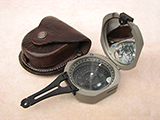
Originally designed by a Canadian geologist named D W Brunton in the late 19th century, the Brunton compass is still very much the first choice of many geologists for field mapping of geological objects.
This particular example is the 'International Model by The Brunton Company, Riverton, Wyoming' and comes with it's original Brunton branded leather case.
In very good condition and fully working, it measures between 70mm -75mm in width and 28mm in height.
Weighs just under 200 grams without it's case and 270 grams with.
| SOLD | Select your shipping destination at ORDER page | |||||
| Price | Code | UK | EU | USA/CAN | AUS/ NZ | RoW |
| SC2612 | ||||||
Click Image to View Gallery
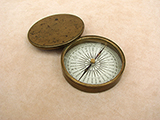
This is an elegant Victorian brass cased travellers compass with a very clean traditional dial, denoting 32 cardinal and inter cardinal points, under a clean crystal.
The stylish blued steel needle has N & S engraved in gold lettering for clarity, and the brass case is in good original condition.
A fine antique compass dating to the mid 19th century, it has the classic compass rose design with a distinctive Fleur de Lis crest denoting North.
In full working order, measuring 55mm diameter by 10mm deep, it weighs just over 70 grams, and comes with a modern velvet drawstring pouch for added protection.
| SOLD | Select your shipping destination at ORDER page | |||||
| Price | Code | UK | EU | USA/CAN | AUS/ NZ | RoW |
| SC2622 | ||||||
Click Image to View Gallery
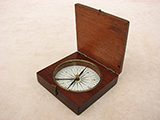
The Chadburn family has a long history in the manufacture of scientific instruments during the 19th century and this example of a mid Victorian pocket compass is signed 'CHADBURN & SON, LIVERPOOL' being Charles Henry and his son William, who worked in Liverpool between 1857 to 1875.
Set in a hinged mahogany block 65mm square with a shapely blued-steel needle engraved N & S in faded gold lettering, it has a paper dial divided into four 90 degree quadrants.
The needle is held by a transit lock which comes into play when the lid is closed and is fastened with an attractive 7 shaped brass clasp.
Interestingly, on the inside lid is hand scribed "Needle points 17° ? W of N", I think this may indicate the magnetic declination of that time, which according to historical declination charts puts the inscription around 1890.
In good working order, an antique compass with a traditional design.
| SOLD | Select your shipping destination at ORDER page | |||||
| Price | Code | UK | EU | USA/CAN | AUS/ NZ | RoW |
| SC2539 | ||||||
Click Image to View Gallery
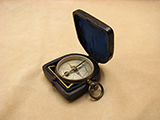
Signed 'STANLEY LONDON' this is a rare example of a distinctive pocket compass and clinometer, from the late Victorian period.
Previously owned by a member of the
the Geological Survey of Scotland which was formed in 1869, it has their logo 'G.S' with a crown symbol engraved on the reverse.
North is indicated by an English cross bar needle with a gemstone bearing, above a decorative silvered dial divided into four 90 degree quadrants.
It also incorporates a pendulous arm for measuring rise & fall, all housed under a clean glass crystal.
In very good condition, the brass body is free of any dings or dents with some light tarnishing on the underside.
It also comes with its original fitted leather case which is in very good condition and snaps shut firmly.
In good working order, including a push button transit lock, it weighs just over 100 grams in its case, which measures 65mm x 60mm x 25mm.
| SOLD | Select your shipping destination at ORDER page | |||||
| Price | Code | UK | EU | USA/CAN | AUS/ NZ | RoW |
| SC2624 | ||||||
Click Image to View Gallery
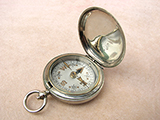
An iconic WW1 British Army Officers MK VI pocket compass, engraved 'Dennison Birmingham VI 56704 1917' with the military arrow on the lid, showing it was issued in to service.
Housed in a full hunter nickel case, the beveled glass crystal covers an attractive jewelled bearing floating dial, which has all its original markings intact.
In excellent cosmetic condition and fully working, it measures 45mm in diameter not including the stem.
A fine example from the most prolific maker of this style of compass
| SOLD | Select your shipping destination at ORDER page | |||||
| Price | Code | UK | EU | USA/CAN | AUS/ NZ | RoW |
| SC2614 | ||||||
Click Image to View Gallery
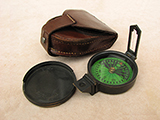
Pocket compasses with the distinctive Singer's Patent dial are not that uncommon, but very rarely hand drawn on a green card dial.
This type of compass was a development of Schmalcalder's Patent compass of 1812 which introduced the idea of using an optical prism, combined with a sighting vane, to improve accuracy when taking bearings.
The British Army used this type of compass from the last quarter of the 19th century, and this particular example comes with its leather case bearing the name of a later owner and the letters 9th K.S.L.I, referring to the 9th battalion Kings Shropshire Light Infantry.
In good working order, the brass case with a push fit lid is in very good condition with no dents or damage and measures 50mm in diameter, which is smaller than usual for these prismatic compasses.
Dating to the late 19th century, the compass itself has no makers marks, but it is identical to similar ones produced by Francis Barker & Son, so very likely made by them.
| SOLD | Select your shipping destination at ORDER page | |||||
| Price | Code | UK | EU | USA/CAN | AUS/ NZ | RoW |
| SC2606 | ||||||
Click Image to View Gallery
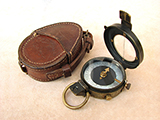
This is a WW1 Verner's pattern MK VII prismatic marching compass dated 1916 with leather case.
Engraved on the underside is CRUCHON & EMONS, LONDON, No 50003, 1916' and stamped with the British Army War department arrow.
In very good condition all round, with a Mother of Pearl dial for low light reading, it has a gemstone bearing for reduced friction and there is a manual transit lock.
The brass case is dent free retaining its anti slip rubber ring on the underside, the leather case is also in good condition.
In good working order, a genuine piece of Britain's WW1 history.
| SOLD | Select your shipping destination at ORDER page | |||||
| Price | Code | UK | EU | USA/CAN | AUS/ NZ | RoW |
| SC2618 | ||||||
Click Image to View Gallery
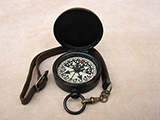
This compass has the Royal Geographical Society pattern dial which was designed by Francis Barker, and dates from the latter part of the 19th century.
Although there are no maker's marks, this compass design appeared in many Barker catalogues, from the late 19th century until the 1920s.
In very good condition, it retains all of its original black finish and is in full working order, including the transit lock. Measuring 46mm in diameter, it also comes with a leather strap from around the same period.
| SOLD | Select your shipping destination at ORDER page | |||||
| Price | Code | UK | EU | USA/CAN | AUS/ NZ | RoW |
| SC2616 | ||||||
Click Image to View Gallery
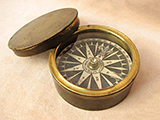
Dating to the mid 19th century, this English brass cased explorers style compass is marked to the centre of the distinctive floating dial “Spencer & Co, 111 Minories, London.”
Made by Spencer Browning & Co who were a continuation of the firm Spencer Browning & Rust on the death of Ebeneezer Rust, they were recorded as working at the Minories address from 1840 to 1873.
In good original condition, the case is free of any dents and the card dial has only minor scuffing around the makers name.
Housed in a dent free brass case with its original push fit lid, it's in full working order and measures 65mm diameter by 25mm deep.
An impressive and relatively rare antique compass by a renowned maker of the 19th century, this is one for the collector.
| SOLD | Select your shipping destination at ORDER page | |||||
| Price | Code | UK | EU | USA/CAN | AUS/ NZ | RoW |
| SC2605 | ||||||
Click Image to View Gallery
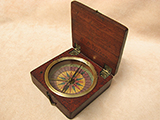
A rare mahogany cased pocket compass with a very decorative hand drawn coloured dial.
It measures 65mm x 62mm x 22mm deep and in remarkably good condition for a piece which is well over 200 years old.
In good working order, the retaining ring has a small piece of brass inserted so may be a later replacement.
Interestingly, the lid has a previous owners name along with some other illegible text written inside.
| SOLD | Select your shipping destination at ORDER page | |||||
| Price | Code | UK | EU | USA/CAN | AUS/ NZ | RoW |
| SC2572 | ||||||
Click Image to View Gallery
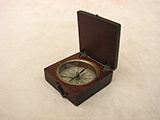
This is a very elegant early 19th century pocket compass circa 1820, set in a hinged mahogany block.
It has a shapely blued steel needle pivoting over a clean starburst paper dial divided into four quadrants of 90 degrees, and also showing all the points of the compass.
The lid has small hand made triangular hinges, and is fastened with an elegant 7 shaped brass clasp.
Measuring just over 50mm square and weighing just over 30 grams, this is a classic Georgian compass, in good working order including the transit lock, it comes with a modern velvet drawstring pouch for added protection.
| SOLD | Select your shipping destination at ORDER page | |||||
| Price | Code | UK | EU | USA/CAN | AUS/ NZ | RoW |
| SC2569 | ||||||
Click Image to View Gallery
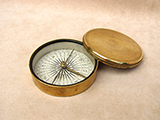
This visually impressive brass cased explorer’s style pocket compass with a separate push fit lid was made by Francis Barker & Son around 1880, as evidenced by the small FBS logo within the Trademark London triangle and printed on the card dial just below the North cardinal point.
Measuring 70mm diameter and 20mm deep, the inverted S in the logo indicates the compass was made after Francis Barkers death in 1875.
The English cross bar directional needle pivots on a gemstone bearing above a traditional sunburst dial, denoting 32 cardinal and inter cardinal points under a clean undamaged crystal.
A quality antique compass by the most renowned of all compass makers, and in full working order, including a lid activated transit lock.
| SOLD | Select your shipping destination at ORDER page | |||||
| Price | Code | UK | EU | USA/CAN | AUS/ NZ | RoW |
| SC2566 | ||||||
Click Image to View Gallery
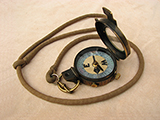
This is a rare example of a WW1 era Verner's Pattern MK VI prismatic marching compass which was superseded by the more common MK VII shortly after the start of WW1.
It's dated 1910 and signed 'E.R. WATTS & SON, LONDON. 1910, No 163' on the underside and 'VERNER'S PATTERN VI' on the lid.
The MK VI is much less common and unusual to find in such good condition, particularly with its centre paper label completely intact, as well as retaining its original lubber line on the glass.
In good working order, it comes with a WW1 Webley lanyard and has the mother of pearl dial for low light readings.
Not only a sought after compass for a collector, it's still practical today for hill walking and similar pursuits, and comes with a modern velvet drawstring pouch for added protection.
| SOLD | Select your shipping destination at ORDER page | |||||
| Price | Code | UK | EU | USA/CAN | AUS/ NZ | RoW |
| SC2590 | ||||||
Click Image to View Gallery
The majority of MK V pocket compasses were made during the WW1 period up to 1917 when they were superseded by the MK VI version.
This 1914 example by Short & Mason is engraved on the lid 'Short & Mason Ltd, London, 1914, V, 11774', it also has the military arrow, showing that it was issued into service.
It has a bevelled glass crystal covering the distinctive Singers patent style black & white floating dial, which is mounted on a jewelled brass bearing for reduced friction on the pivot point.
Housed in a full hunter nickel case, it's in full working order, with a strong hinge and measures 45mm in diameter, not including the stem.
| SOLD | Select your shipping destination at ORDER page | |||||
| Price | Code | UK | EU | USA/CAN | AUS/ NZ | RoW |
| SC2589 | ||||||
Click Image to View Gallery
Made toward the latter part of the 19th century, this brass cased green card dial prismatic compass with folding sight vane is inscribed "Chas Owen Optician 46 & 48 City Rd EC" and "W. H. H. Waters" on the reverse.
Belonging to noted author, soldier and diplomat Brigadier General Wallscourt Hely Hutchinson Waters, R.A. C.V.O (Royal Artillery Commander of Victorian Order) born in 1855, he became Captain of 13th Battery Royal Field Artillery based out of Suffolk in 1891, and was later appointed as military attaché in 1893 at the British Embassy in Russia for the next five years.
After duty in South Africa, he was sent in 1904 as the War Office representative with the Russian army in Manchuria traveling extensively across Russia. His final visit before the October Revolution came in October 1916, when he had an audience with Tsar Nikolai II Alexandrovich Romanov at his headquarters in Mogilev.
He was also a personal friend and admirer of the final German Emperor Kaiser Wilhelm II, having become acquainted in the early 1900s after he wrote favourabley of Wilhelm in his memoirs. (A Collection of books inscribed to Brigadier Wallscourt Hely-Hutchinson Waters, by Kaiser Wilhelm II were sold at auction in 2018) see photo of one example.
Waters would go on to release notable publications including 'The War in South Africa', 'Secret and confidential : the experiences of a military attaché', and 'Russia Then & Now'.
The compass itself is in good cosmetic condition with a clean crystal under which the dial pivots on a gemstone bearing and a transit lock. Measuring 70mm diameter, it comes with its original leather case which has had a small repair on the locking strap but is also in good condition with sound stitching.
The leather case is impressed with initials "W.H.H.W." and written in ink "W.J."
In good working order, the compass and case together weigh just under 300 grams.
| SOLD | Select your shipping destination at ORDER page | |||||
| Price | Code | UK | EU | USA/CAN | AUS/ NZ | RoW |
| SC2581 | ||||||
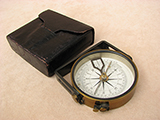
Click Image to View Gallery
This is an early 20th century example of a Handle compass clinometer, also known as a bridge compass, made by Francis Barker.
In very good condition the brass body retaining much of its original lacquer finish, it also comes with its original leather case.
In good working order, the cross bar needle pivots on a gemstone bearing above a paper dial which has the F Barker and Son logo within the trademark London triangle, just under the North cardinal point.
| SOLD | Select your shipping destination at ORDER page | |||||
| Price | Code | UK | EU | USA/CAN | AUS/ NZ | RoW |
| SC2573 | ||||||
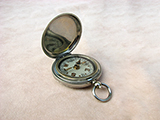
Click Image to View Gallery
Although dating to the WW1 period, this Dennison MK VI pocket compass was never issued to the military and made on a wholesale basis for other makers to rebrand on the lid, hence the lack of any markings on the lid.
However, it is the same Dennison compass that would have been issued to the military, having the matching serial numbers on the lid and base, and stamped 'DENNISON WATCH CASE CO LTD' inside the base cover.
Measuring 45mm in diameter, it's in good working order and in clean condition as can be seen from the attached Photos, with no dents or chipping on the glass.
| SOLD | Select your shipping destination at ORDER page | |||||
| Price | Code | UK | EU | USA/CAN | AUS/ NZ | RoW |
| SC2560 | ||||||
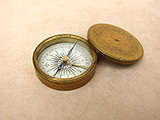
Click Image to View Gallery
This is an elegant Victorian brass cased travellers compass with a very clean traditional dial, denoting 16 cardinal and inter cardinal points, under a clean crystal.
The stylish blued steel needle has N & S engraved in gold lettering for clarity, and the brass case is in good condition with no dents.
A fine antique compass dating to the mid 19th century, it has the classic compass rose design with a distinctive Fleur de Lis crest denoting North and its original brass push fit lid activates a transit lock when in place.
In full working order, measuring 45mm diameter by 12mm deep, it weighs just over 50 grams, and comes with a modern velvet drawstring pouch for added protection.
| SOLD | Select your shipping destination at ORDER page | |||||
| Price | Code | UK | EU | USA/CAN | AUS/ NZ | RoW |
| SC2582 | ||||||
Click Image to View Gallery
A late 19th century hunter cased pocket compass stamped ROSS LONDON on the lid, and measuring 45mm in diameter
In very good condition, direction is indicated by an English cross bar needle with a gemstone pivot bearing above a decorative silvered dial, all housed under a clean glass crystal.
A sturdy compass in full working order, the brass case is free of any dents and activates a transit lock when the lid is closed.
| SOLD | Select your shipping destination at ORDER page | |||||
| Price | Code | UK | EU | USA/CAN | AUS/ NZ | RoW |
| SC2565 | ||||||
Click Image to View Gallery
Dating to the second half of the 19th century, this French equinoctial compass sundial is housed in a polished mahogany case measuring 95mm square.
The blued steel needle pivots on a gemstone bearing over a polished aluminium dial with a 360 degree stepped chapter ring, under a clean crystal held in place by a brass retaining plate.
Above the glass sits the folding latitude arc with divisions from zero to 70 degrees and a sundial gnomen for noting the hours.
Weighing just under 220 grams and in good working order, the case lid is fastened with two shapely brass clasps which also activates the needle transit lock.
| SOLD | Select your shipping destination at ORDER page | |||||
| Price | Code | UK | EU | USA/CAN | AUS/ NZ | RoW |
| SC2533 | ||||||
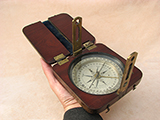
Click Image to View Gallery
This large surveying compass was made around the middle of the 19th century by James Gargory, an optician and instrument maker who operated out of Birmingham and Wolverhampton between 1830 to 1875, and died in 1881.
The attractive silvered dial is signed "J. Gargory Fecit. 41 Bull St, Birm'n"and has a stepped outer chapter ring with a 0-360 degrees scale in one degree increments.
He is recorded as working at the 41 Bull St address between 1850 to 1856.
A substantial compass weighing just under 800 grams and measuring 5 ½ (135mm) square, it's visually very impressive, despite the fact that it's had noticeable repair work on the lid and hinge (see Photos).
In good working order including the transit lock, the lid is designed to lift off and it also comes with a removable tripod adapter.
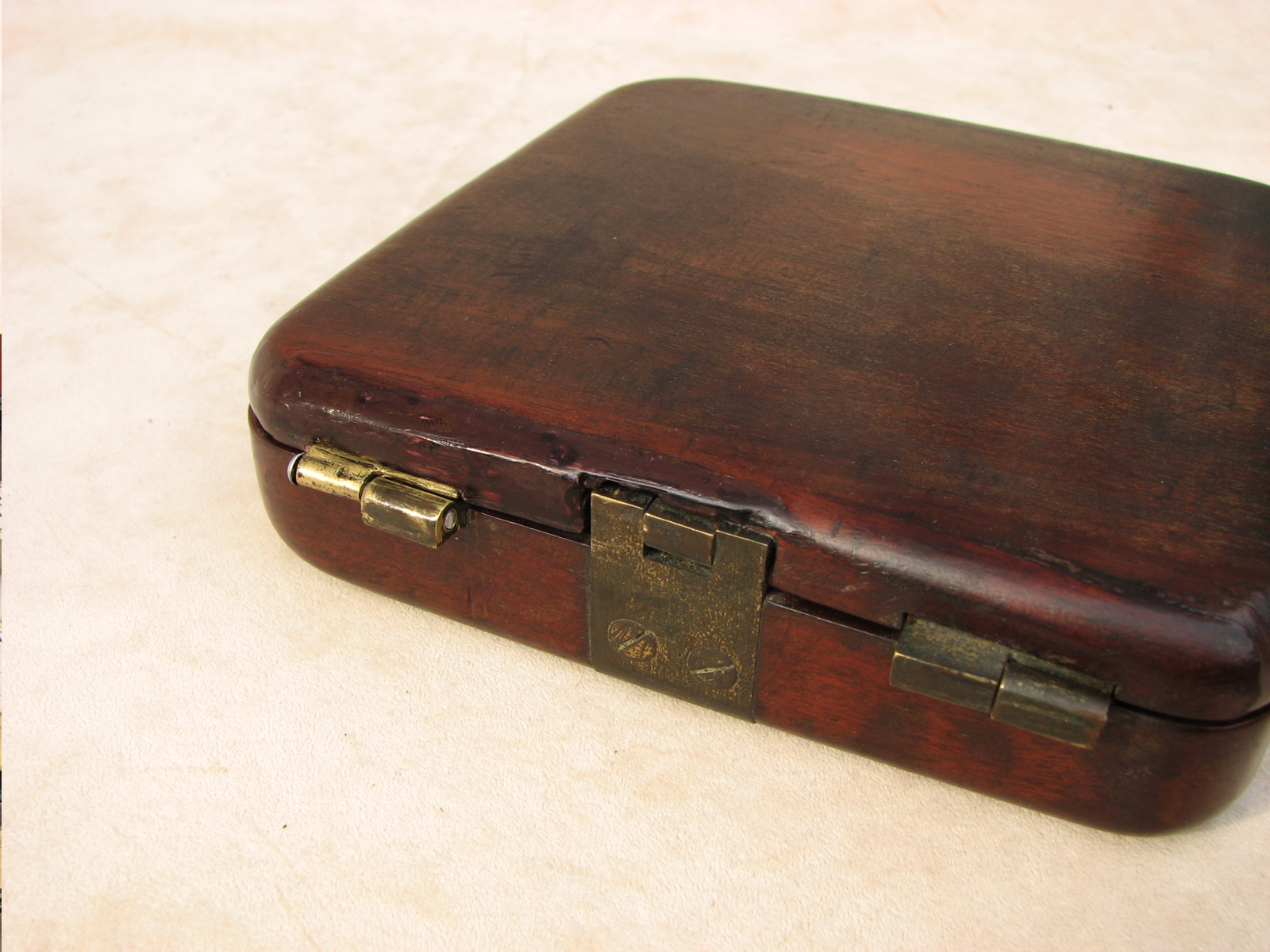
| SOLD | Select your shipping destination at ORDER page | |||||
| Price | Code | UK | EU | USA/CAN | AUS/ NZ | RoW |
| SC2453 | ||||||
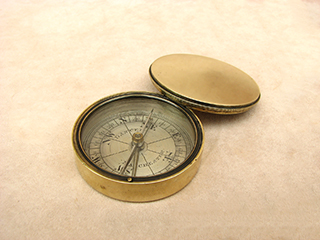
Click Image to View Gallery
This early Victorian brass cased pocket compass is inscribed "DANCER MANCHESTER" on the dial.
Made by the celebrated Manchester optician John Benjamin Dancer, son of Josiah Dancer whose business he inherited in 1835, Dancer was a scientific instrument maker who lived from 1812 to 1887 and was renowned for his many contributions to the field of optics, barometers and microscopy.
Elected as a Fellow of the Royal Astronomical Society in 1855, he was later appointed Optician to HRH the Prince of Wales.
In good condition, the English cross bar needle pivots on a gemstone bearing for reduced friction, above an aluminium dial divided into four 90 degree quadrants, protected by a clean glass crystal.
Measuring 50mm in diameter, the compass is in working order including the transit lock, activated by lid closure.
Pocket compasses by Dancer are relatively rare given his main interests were in other fields, and examples like this do not come along too often.
| SOLD | Select your shipping destination at ORDER page | |||||
| Price | Code | UK | EU | USA/CAN | AUS/ NZ | RoW |
| SC2558 | ||||||
Click Image to View Gallery
An impressive gimbal mounted mariners compass dating to the mid 19th century.
The floating dial pivots on a gemstone bearing, with the outer scale marked in four 90 degree quadrants, and a fleur de lis denoting North.
In generally good condition all round, there is some minor damage on the very outer edge of the card dial at the South position (see photo).
The compass is mounted in a dovetail jointed mahogany box with a later mahogany lid, dimensions are 5¾" square by 4" high, and the lacquered brass bowl diameter is just under 3¾".
In good working order, this fine decorative antique weighs just under 950 grams.
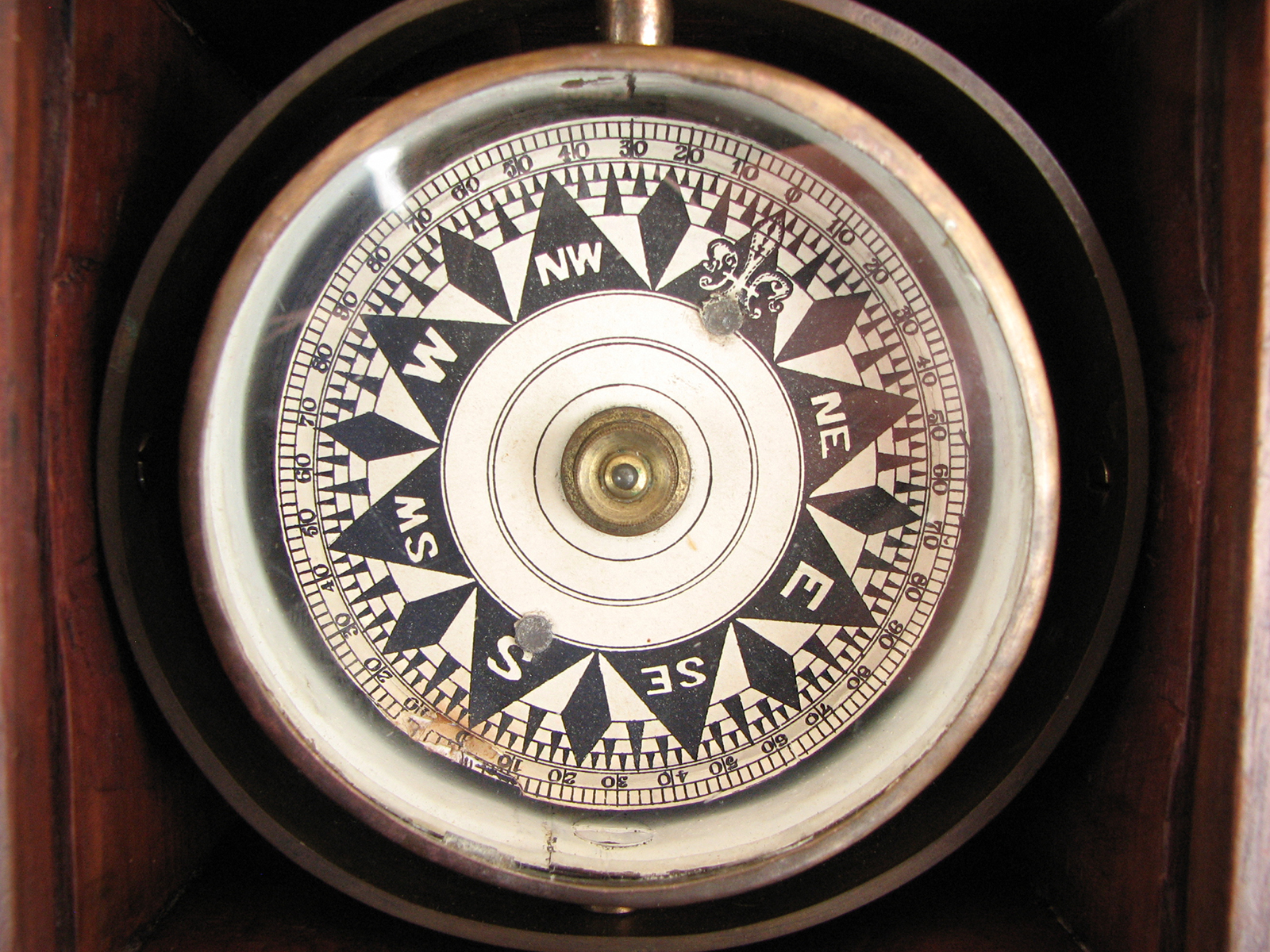
| SOLD | Select your shipping destination at ORDER page | |||||
| Price | Code | UK | EU | USA/CAN | AUS/ NZ | RoW |
| SC2516 | ||||||